OVERVIEW
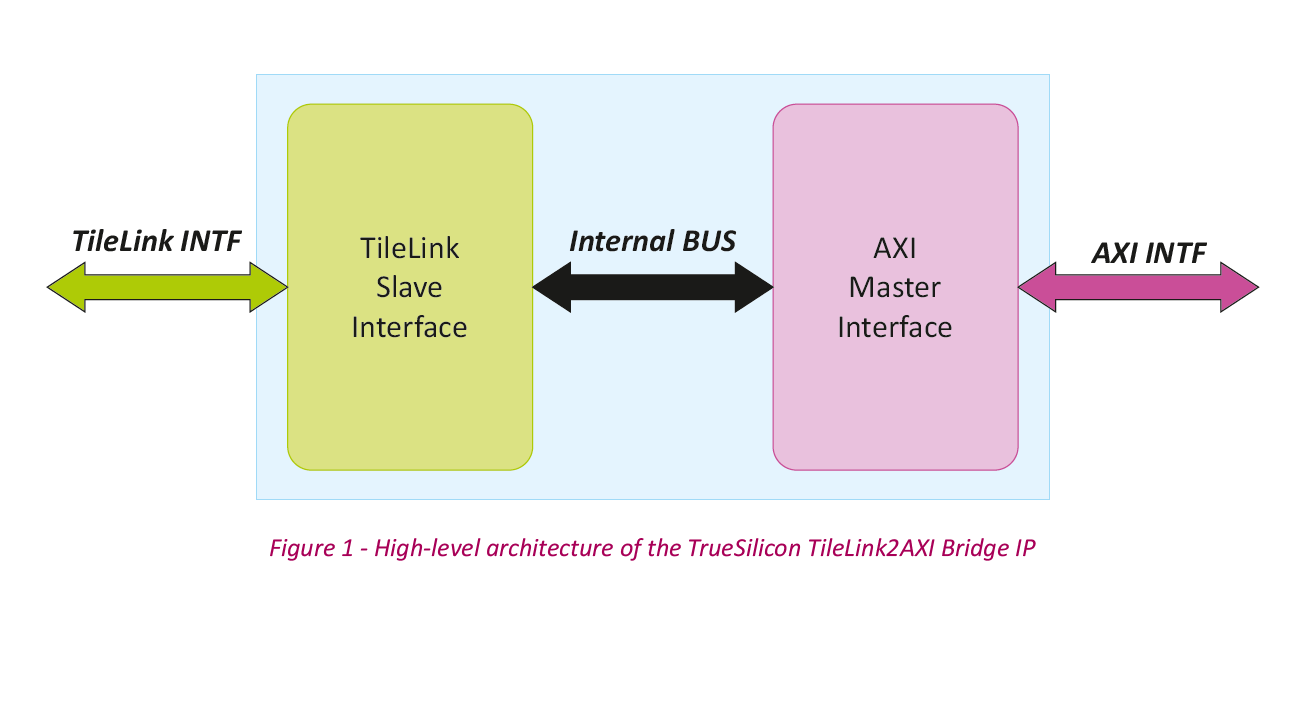
The TileLink2AXI Bridge is a synthesizable, high-performance IP designed to provide seamless interoperability between TileLink-based components and AMBA AXI-based subsystems in modern System-on-Chip (SoC) designs. Functioning as a protocol conversion layer, the bridge translates TileLink A and D channel transactions into AXI channel-based operations, including AW, W, AR, R, and B channels, thereby enabling efficient integration of heterogeneous interfaces within a unified architecture.
The bridge supports comprehensive protocol translation while preserving transaction semantics and data integrity. TileLink multi-beat transactions are converted into AXI burst transfers, with precise mapping of transfer size, byte enable masks, and write strobes to ensure correct data alignment and consistency. Additionally, TileLink source identifiers are mapped to AXI transaction IDs, facilitating accurate tracking and correlation of requests and responses across the interface.
To ensure protocol compliance, the bridge maintains TileLink ordering constraints while supporting multiple outstanding transactions through robust in-flight tracking mechanisms. Independent flow control is implemented between request and response paths, allowing decoupling of TileLink and AXI channels to enhance throughput and minimize backpressure effects.
The architecture incorporates flexible data width adaptation, supporting both upsizing and downsizing between TileLink and AXI interfaces. Beat packing and unpacking mechanisms are employed to optimize bandwidth utilization when interfacing components with differing data widths. Furthermore, AXI response codes are translated into TileLink-compliant error signaling, ensuring consistent and reliable error handling.
For integration in complex SoC environments, the bridge provides optional clock domain crossing (CDC) support using asynchronous FIFOs, enabling safe communication across distinct clock domains. It also includes flexible reset domain handling, allowing either synchronization or isolation of reset signals to improve system robustness and fault isolation.
Delivered as a configurable RTL IP optimized for power, performance, and area (PPA), the TileLink2AXI Bridge integrates efficiently into heterogeneous SoC architectures. By combining accurate protocol conversion, scalable concurrency support, data width flexibility, and robust system-level features, it provides a reliable and production-ready solution for bridging TileLink and AXI ecosystems.
KEY HIGHLIGHTS
Ø TileLink to AXI protocol conversion supporting A/D to AXI AW, W, AR, R, B channels
Ø Support for TileLink multi-beat transactions translated into AXI burst transfers
Ø Accurate mapping of transfer size, byte mask, and data strobes between protocols
Ø Efficient ID management with TileLink source to AXI ID mapping
Ø Preservation of TileLink transaction ordering across the AXI interface
Ø Data width adaptation with configurable upsizing, downsizing, and beat packing/unpacking
Ø AXI response to TileLink error conversion for protocol-compliant error handling
Ø Decoupled flow control between request and response paths for improved throughput
Ø Support for multiple outstanding transactions with in-flight tracking
Ø Optional clock domain crossing (CDC) using asynchronous FIFOs
Ø Flexible reset domain handling with synchronization or isolation support